


You’re the type of artist who would rather stay creative than stay stuck. Well that’s just perfect, because we’ve compiled 50 fun things to do when you have zero inspiration. We pulled a little from here and a little from there, flipped every couch cushion in the studio, and shook loose everything that has ever actually unblocked us or an artist we know. Some of these get you out of the house. Some of them give you permission to make gloriously bad art. Some of them you can do from the couch without putting on real pants.
If you make it to the bottom and didn’t see your go-to trick, be sure to leave it in the comments. We’re taking this list to 100, and the best additions get added to the list with your name on them. Deal? Deal. Let’s get you unstuck.
Fun things to do when you’re artist blocked (get out of the studio edition)
1. Take yourself on an artist date to a real museum
Julia Cameron calls it an artist date, we call it refilling the tank. Wander a museum with no goal except looking. If you’re near us, the Cincinnati Art Museum in Eden Park is free every day, and even the ticketed exhibitions are free on Thursday evenings. Five thousand years of other people’s ideas is a lot of kindling for yours.
2. Get weird at a contemporary gallery
When your own style starts feeling stale, go look at work that makes you say “wait, you can DO that?” Contemporary galleries are pattern interrupts with track lighting. Our hometown pick is the Contemporary Arts Center in downtown Cincinnati, free to get in, inside a building designed by Zaha Hadid that is basically a sculpture you can walk around in. Not local? Find the weirdest gallery near you and go get your brain bent.
3. Slow-look one painting at the Taft
The Taft Museum of Art is a historic house full of quiet rooms and the Duncanson murals, and it’s free on Sundays and Mondays. Pick ONE painting, sit with it for fifteen minutes, and sketch what you see. Slow looking is a superpower most of us never train, and it will absolutely change how you look at your own work. Not near Cincinnati? Every city has a version of this place, some house museum or quiet little gallery where the collection has hung undisturbed forever. Find yours and give it the same fifteen minutes.

4. Do a sketch crawl through a public market
Ohio’s oldest continuously operated public market, Findlay Market, is a riot of color, signage, produce pyramids, and people. Bring a sketchbook, buy a snack, and hunt for still lifes. Any busy market works for this one. Vendors have seen weirder than you sketching their eggplants, promise.
5. Refill your color vocabulary at a conservatory
Krohn Conservatory and the Eden Park overlooks sit right by the art museum, so you can double-dip. Tropical houses, desert rooms, orchids doing their outrageous thing. Half of “no inspiration” is just your eyes being bored of your apartment. Feed them shapes and colors they haven’t seen this week. No conservatory near you? A botanical garden does the same job, and honestly the greenhouse section of a good garden center counts in a pinch.
6. Let someone else lead: go to a paint and sip night
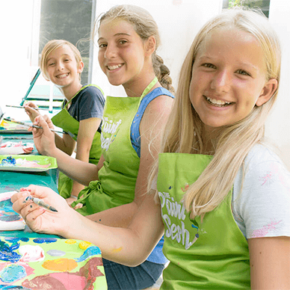
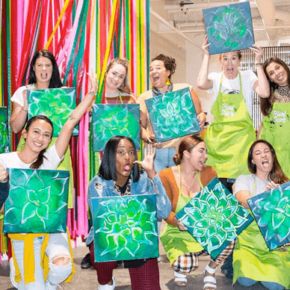
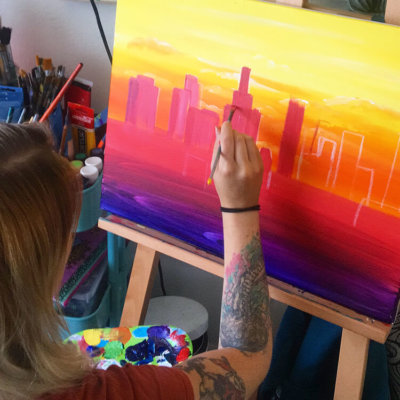
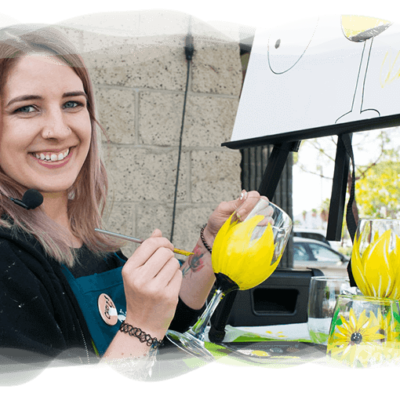
Zero decisions. The painting is picked, the supplies are out, the steps are led, and the room is full of people cheerfully making imperfect art. Half the time the block isn’t talent, it’s the pressure of a blank canvas and no starting line. A paint night hands you a starting line and a drink. Ours are right here if you’re in Cincinnati, and there’s one in basically every city now.

7. Take a one-color photo walk
Pick a color before you leave the house. For the next hour, you may only photograph things that are that color. That’s it. That’s the game. It sounds dumb and it works like a charm, because it forces your eye to actually SEE your neighborhood again instead of autopiloting through it. Your camera roll at the end is also a palette library, which brings us to the stealing section later. Patience.
8. People-watch and gesture-sketch strangers
Park bench, coffee shop, library, food court. Fill pages with 60-second gesture sketches of strangers living their lives. Nobody poses, nobody judges, everything is practice, and real humans in motion are infinitely more interesting than the reference photos you’ve been redrawing. Bonus: overheard conversations are free story prompts.
9. Browse an art supply store with NO list

You are not allowed to buy the responsible thing. Touch the brushes, read the weird paint names, and leave with exactly ONE strange supply you have never used. A new material is a new idea wearing a disguise. The block often isn’t in your head, it’s in your toolbox.
10. Chase public art and murals
Spend an afternoon hunting your city’s murals, sculptures, and weird little art moments hiding in plain sight. Photograph compositions, not just art. A mural you walk past every day becomes a masterclass when you stop and ask why the artist put the bright part THERE. Steal compositions shamelessly. That’s foreshadowing.

Make something gloriously bad
Truth be told, most artist block is just fear of making a bad thing wearing a trench coat. So let’s take the fear’s lunch money. This whole section is permission slips.
11. Paint with your non-dominant hand
Your good hand has opinions and expectations. Your other hand has neither. Everything it makes is wobbly, honest, and weirdly charming, and because it CAN’T be good, your brain finally relaxes back into beginner mode, which is where all the fun was hiding anyway.
12. The 10-minute ugly painting challenge
Set a timer for ten minutes. Finish a whole painting before it beeps, no matter what. Then sign it like it’s a masterpiece, because in one way it is: it’s FINISHED, which is more than the pristine blank canvas on your easel can say.
13. Blind contour drawing
Draw your subject without looking at the page. Not once. The results will be deranged and hilarious, and the exercise quietly welds your eyes to what you’re actually seeing instead of what your brain assumes is there. Do your cat. Do your hand. Do your houseplant. Frame the best disaster.
14. Paint with the wrong tools
Credit cards, sticks, sponges, toothbrushes, old gift cards, your actual fingers. Strange tools make strange marks, and strange marks are new ideas begging to happen. Some of our favorite textures in the studio were accidents committed by a palette knife substitute.

15. Use up your worst, cheapest supplies
The good canvas is precious and terrifying. The dollar store pad has zero expectations and total freedom. Save the fancy surfaces for when the idea is already alive. While it’s still being born, it can live on the cheap stuff.

16. Make the worst painting you possibly can, ON PURPOSE
Lean all the way into ugly. Worst colors, worst composition, worst everything. Somewhere right around peak hideous, most artists notice it circles back around to interesting. And if it doesn’t, you’ve made the worst painting of your life and survived. Either way the fear is dead.

17. Draw from memory only
Draw a horse from pure memory. A bicycle. Your best friend’s face. Then look at a reference and laugh at what your brain invented. Your internal reference library is full of cartoon nonsense, and seeing the gaps is the fastest way to know what to actually study next.
18. Fill a whole page with the thing you’re worst at
Hands? Cars? Horses? Ears? A full page of attempts at your nemesis subject. The first row will be rough. By the bottom row you’ll see real improvement with your own eyes, and the nemesis gets demoted from “thing I avoid” to “thing I’m weirdly into now.”
19. Scribble first, find the picture second
Make a loose, fast scribble. Now hunt through it for the hidden image, a face, a creature, a landscape, and ink what you find. Your subconscious does the brainstorming, you just do the excavating. This one has never once failed to produce at least one idea worth keeping.
20. Paint over your worst old piece
That failure in the corner? Gesso over it and start again on top. Painting over your mistakes is therapy with layers, and the ghost of the old piece sometimes peeks through in the best ways. Nothing is wasted. It’s all underpainting.

Feed your eyes and ears
Sometimes the well is just empty and you need to pour something good into it. Videos, podcasts, endless museum collections. Input is not procrastination when it’s deliberate. Mostly. Okay, sometimes. But this input, specifically, is medicine.
21. Watch the drawing advice that changed Struthless’s life
Campbell “Struthless” Walker built a whole practice on one idea, Draw the Same Thing Every Day. Repetition sounds like the opposite of inspiration until you realize it quietly turns into a style, a body of work, and a habit that doesn’t ask your motivation for permission.
22. Play Proko’s “What If?” game
How to Cure Art Block from Proko features Irshad Karim of Drawabox teaching an idea-generation game that manufactures concepts on demand. “What if a knight… was also a teapot?” is a silly example and also how this works. Stop waiting for ideas to visit. Build a machine that makes them.

23. Adopt the mantra: Finished Not Perfect
Inktober creator Jake Parker’s short pep talk reframes the entire game. A finished imperfect thing teaches you more, and exists more, than a perfect thing that lives forever in the planning stage. Tape “finished, not perfect” to your wall. We did.
24. Hear Elizabeth Gilbert on your elusive creative genius
Her famous TED talk, Your elusive creative genius, argues that creativity is a visiting spirit and your only job is to show up and hold up your end. It is shockingly effective at removing the “but what if I’m not talented enough” static. Twenty minutes. Watch it the next time the static gets loud.
25. Start The Artist’s Way alongside a working artist

Painter Tiffany Tan (Apple Cheeks) filmed herself after a long-term art block: morning pages, artist dates, the whole Julia Cameron program, in Actually Doing The Artist’s Way. Watching a real artist work the system is ten times more motivating than just buying the book and shelving it next to the other self-improvement books. No judgment.
26. Queue up Creative Pep Talk
Andy J. Pizza’s Creative Pep Talk is a weekly podcast that exists for one reason: busting creative blocks. Start with episode 438, the quick-fix creative rut episode, and then just let the back catalog do its thing while you clean brushes or drive. Half of unblocking is remembering you’re not the only one who’s been blocked.
27. Binge The Lonely Palette
The Lonely Palette covers one famous painting per episode, explained like a story you’d tell a friend. It’s the fastest way we know to fall back in love with looking at art, and loving looking is the root system under loving making. Short episodes. Zero homework energy.
28. Listen to painters talk shop
Real painters describe real studio struggles and wins, including the dry seasons, on Savvy Painter podcast. Start with The 10 Most Important Lessons I’ve Learned as an Artist. And for a daily small dose, Daily Creative is hosted by Todd Henry, who’s Cincinnati-based like us. Local boy. Good prompts.
29. Put on Bob Ross and just watch his hands
Thirty years of artists have unblocked themselves absorbing this man’s calm. A full episode of The Joy of Painting is free on the official channel, and the whole series streams on Prime Video if you want the deep catalog. You don’t even have to paint along. Just let the happy little trees lower your heart rate until your own brush feels light again.

30. Watch a designer’s brain work in Abstract
Netflix’s Abstract: The Art of Design follows one world-class designer per episode through their actual process. Process is contagious. Watching Paula Scher or Christoph Niemann wrestle a problem from nothing to something is the closest thing to osmosis for your own stuck project. Queue it up the next time your own project won’t budge.
31. Scroll a museum’s open collection like it’s social media
The Met Open Access library has 492,000+ public-domain images, free and unrestricted. The Art Institute of Chicago has 50,000+ more. That is an infinite, guilt-free inspiration feed with better content than your actual feed. Doomscroll a few centuries of masters instead. Save what stops your thumb. That pile is your next month of study material.
Steal like an artist
Every artist you’ve ever loved is a magpie with good taste. Originality is just theft that had time to compost. This section is your license, with instructions.
32. Do a master study
Copy a painting you love as honestly as you can, stroke for stroke. You will learn more in one sincere copy than in ten videos about technique, because the master makes a hundred tiny decisions and the copy forces you to notice every single one. This is not cheating. This is the oldest art school on Earth.
33. Steal a color palette from a movie still
Pause a scene you love. Pull the five dominant colors out of it. Now paint something entirely yours using only those five. A great film colorist just art-directed your next piece for free, and the result will feel weirdly cinematic because it literally is.

Palette via @colorpalette.cinema on Instagram.
34. Remix your own old work
Pull out a piece from two years ago and repaint it with everything you know now. Same subject, new you. It’s the most encouraging before-and-after in existence because both sides are yours, and the gap between them is proof the work is working even when it doesn’t feel like it.
35. Style-swap a favorite character
Draw a beloved character in a completely different artist’s style, or a different era’s style. A cartoon mouse as a Renaissance oil painting. Your favorite game character as a 1920s poster. Translation forces invention, and the results are usually hilarious enough to share.
36. Make unapologetic fan art
Drawing what you already love deletes the “but what should I make” question entirely. Joy first, originality later. Fan art communities are also some of the most encouraging corners of the internet, and encouragement is rocket fuel when you’re running on empty.

37. Copy the composition, change everything else
Take a master’s layout, the bones, where the eye enters, where the weight sits, and dress it in your subject, your colors, your world. Composition is the least ownable and most teachable part of a painting. Borrow the skeleton. Grow your own creature on it.
38. Adopt some art parents
The Draftsmen podcast calls it adopting art parents: deliberately choose the two or three artists whose DNA you want in your work, then study only them for a month. A small family tree beats random influence soup, and their “Solving Creative Blocks” episode belongs in your ears regardless.
39. Recreate a famous painting with stuff around your house

Museums ran this challenge during lockdowns and people lost their minds in the best way: recreate a famous artwork as a photo using only household objects, pets, and family members. It’s ridiculous, it’s physical, and it’s secretly a masterclass in composition and lighting. Your group chat will thank you.
40. Steal from a completely different art form
A song’s structure. A poem’s rhythm. A building’s proportions. A dancer’s timing. Cross-medium theft is where the actually fresh ideas live, because nobody in your medium is looking over there. Translate something you love into paint and see what survives the trip. The weird survivors are the gold.
Low-battery creativity
That spark have you couch-locked? Here’s the section for when the will to art is present but the body is horizontal. No shame. Recovery is part of the process, and so is the couch.
41. Color in a coloring book like it’s your job
All the soothing motion of making, none of the decisions. A coloring book is a legitimate on-ramp back to the studio: the lines are decided, the only job is color and calm. Ten minutes of it has restarted more art practices than any motivational poster ever printed.

42. Order a paint-at-home kit and paint on the couch

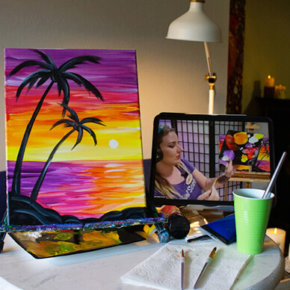
When even gathering supplies is too much, remove the gathering. Our Paint and Sip Kit is $35 and shows up with everything in one box: two glasses of your choice, brushes, a 15-piece acrylic paint set, a palette, even the apron. Activation energy: basically zero. Couch painting is valid painting. Fight us.
43. Take a virtual museum tour from bed
Google Arts & Culture lets you walk the halls of world museums and zoom into gigapixel artworks until you can see individual cracks in the varnish, all without putting on pants. Bed museum counts as a museum. We checked with ourselves and we said yes.
44. Organize and swatch everything

Sort the pencils. Wash the brushes. Swatch every paint you own onto one big honest chart. Half of what feels like a block is just forgetting what your supplies can do, and rearranging your tools has a suspicious way of rearranging your head. Future you, mid-project, hunting for that one green, says thanks.
45. Start morning pages
From Julia Cameron’s The Artist’s Way (see number 25 up there): three longhand pages of whatever is in your head, first thing, every morning. No editing, no rereading, no art required. It drains the static so the signal can get through, and blocked artists have sworn by it for thirty years because it keeps working.
46. Let a prompt wheel decide for you
Outsource the decision entirely. Spin the Picker Wheel art block wheel with its 100 built-in ideas, or the FirstArtBooks prompt generator for a character, mood, and action. Whatever it lands on, you draw. Obedience is the trick. Your taste was the bottleneck anyway.
47. Do a timed gesture session online
Quickposes and Line of Action serve you a new pose every minute or two and your only job is to keep up. No time to judge, no time to stall. Twenty minutes of this makes your hands remember they work for you. SketchDaily is the third member of this little gym.

48. Follow a course one lesson at a time
Drawabox is a free, structured drawing-fundamentals course that removes the “what should I practice” question forever. The answer is always just: the next lesson. On low-battery days, having the track already laid is the whole difference between doing a lesson and doing nothing.
49. Join a low-stakes drawing challenge
Inktober hands you a prompt a day every October, and its Inktober52 list runs weekly all year. Tiny, public, finishable. A word a day is a small enough promise to keep, and a kept streak is inspiration’s favorite food.

50. Fill one page. Any page.
Not a good page. One page of marks, doodles, thumbnails, lists of ideas, a truly terrible drawing of your shoe. The streak matters, not the page. Every artist you admire has thousands of garbage pages under the good ones, and the only unforgivable page is the blank one that stayed blank because it was waiting to be worthy.

Bonus: Take a nap
Not a metaphor. An actual nap, on an actual couch, with an actual timer if you are the type who needs permission. Half the blocks we have ever met were just exhaustion wearing a trench coat, and no supply run or pep talk fixes tired. Sleep is when your brain files the day’s ideas where you can actually find them. Twenty minutes. When you wake up, the canvas looks different, because you are different: rested. Come back with a fresh brain and watch the problem shrink.

Help us take this list to 100
That’s our 50. Now we want yours.
What’s the trick that actually gets YOU unstuck? The weird ritual, the specific video, the place you go, the terrible-first-draft game you play with yourself? Drop it in the comments below. The best additions get added to this list with your name on them, and we’ll keep growing it until it hits 100.
And if your block is the “I just need someone to hand me the canvas and tell me what to paint” kind, well. We do that every week in Cincinnati. Come make a gloriously imperfect painting with us. Finished, not perfect, remember?




I like to go for a walk/hike, or get out in the garden to clear my thoughts and invoke the creative energy.